How Do I Choose the Right Solar Battery for My RV?
What Should You Look For In An RV Solar Battery?
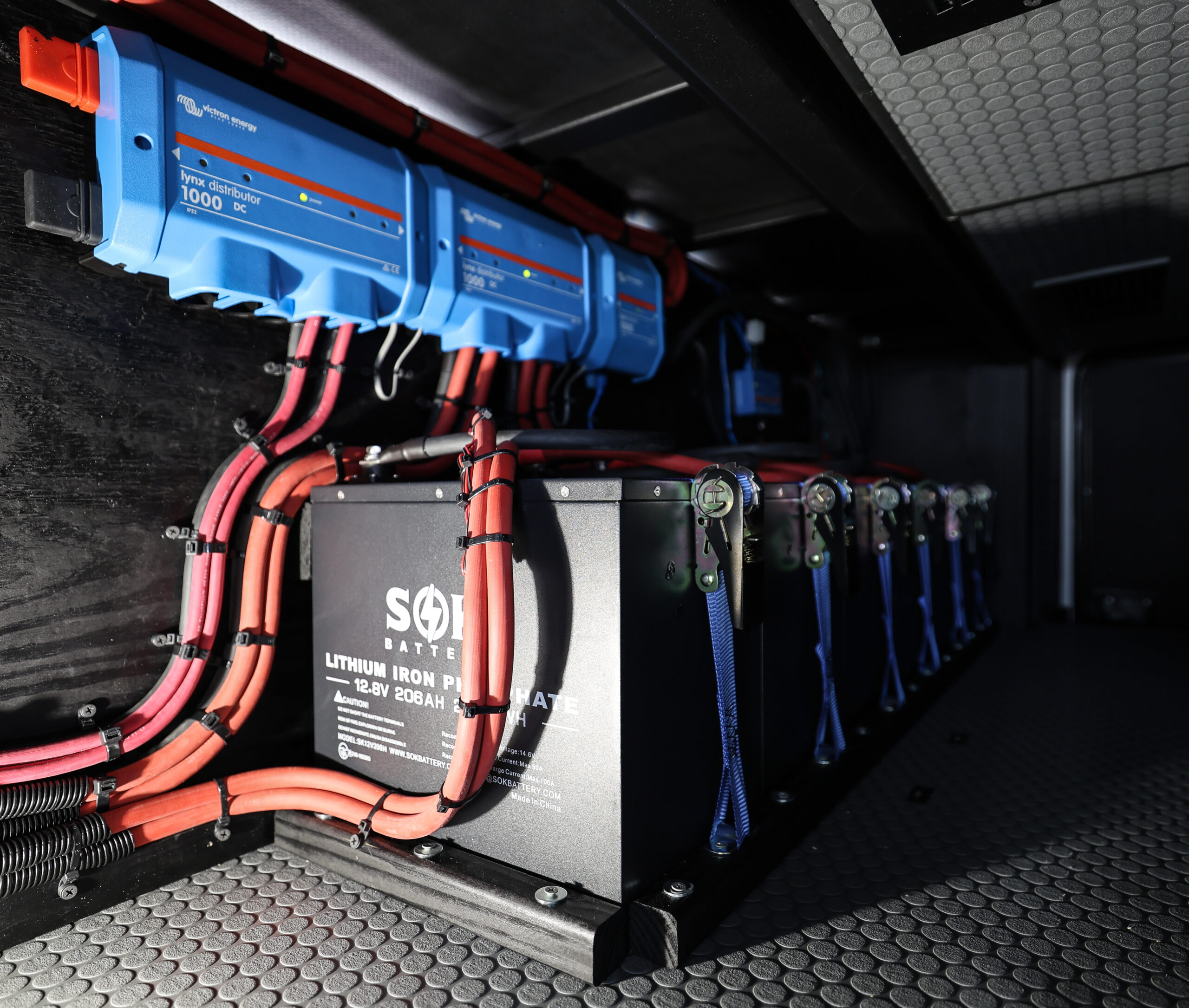
Choose an RV solar battery by matching its usable energy, discharge capability, charging requirements and physical size to your RV. At Go RV Solar, our lithium battery options include SOK 314Ah and Epoch Essential 300Ah, Essential 460Ah and Elite 460Ah models. The right choice depends on how you camp and how the battery fits into the complete system.
Start with an ordinary day in your RV. What runs overnight? What stays on while you’re away? Do you want to make breakfast, work all afternoon or cool the bedroom before bed?
Those answers tell you more than choosing the biggest amp-hour number you can afford.
First, Understand What The Battery Does
Your solar panels generate electricity, the charge controller regulates charging, and the battery stores energy for later. When you use 120V appliances off-grid, the inverter draws energy from that battery bank.
A larger battery gives you more storage. It doesn’t make your panels produce more electricity. If you use more than you put back each day, even a large bank will eventually run low.
That’s why battery size and charging capacity need to be planned together.
Learn more about RV solar system components and how they work together.
1. Estimate How Much Energy You Use Each Day
Make a list of what you actually run, with approximate wattage and daily operating time. The basic calculation is:
Watts × hours of use = watt-hours per day.
For example, a device drawing 60 watts for five hours uses 300 watt-hours. A 1,200-watt appliance used for ten minutes uses about 200 watt-hours.
That second example surprises people. A small device left on all day can use more total energy than a powerful appliance used briefly.
Include refrigeration, lights, fans, water pump use, internet equipment, computers and any other regular loads. For cycling appliances such as refrigerators, measured daily consumption is more useful than assuming the nameplate wattage runs continuously. Also account for inverter losses and its own energy use.
Decide how much time you want to cover without meaningful recharging. One overnight stop and two cloudy days are very different battery requirements.
2. Compare Watt-Hours As Well As Amp-Hours
Amp-hours describe capacity at a particular voltage. Watt-hours make the stored energy easier to compare:
Nominal volts × amp-hours = nominal watt-hours.
Here are the battery options listed in our RV solar packages:
Battery | Nominal stored energy | Features listed by Go RV Solar |
SOK 314Ah 12V lithium | About 4,019Wh | Heating, Bluetooth and Victron communications |
Epoch Essential 300Ah 12V lithium | 3,840Wh | Heating and Bluetooth |
Epoch Essential 460Ah 12V lithium | 5,888Wh | Heating and Bluetooth |
Epoch Elite 460Ah 12V lithium | 5,888Wh | Heating and Bluetooth |
These energy figures reflect a nominal 12.8V lithium battery voltage. They describe stored energy, not guaranteed energy delivered to your appliances. Your reserve, operating conditions and system losses reduce what you can plan to use.
For an illustrative sizing exercise, suppose your energy budget is 2,000Wh per day, including losses. Two days without charging require 4,000Wh. If you plan to use 80% of the bank and retain a 20% reserve, you would need about 5,000Wh of nominal storage: 4,000 ÷ 0.80.
That’s a planning example, not a universal capacity recommendation. Your own energy budget determines whether one battery or a larger bank makes sense.
3. Check How Much Power The Battery Can Deliver At Once
Capacity and output are separate specifications. A battery may store enough energy for the evening yet be unable to supply the current needed by several appliances at once.
Look at the continuous discharge rating and the battery management system, or BMS, limits. For example, SOK lists a 200-amp maximum continuous discharge rating for its SK12V314PH 314Ah battery. Epoch also lists 200 amps for its Essential 460Ah model. The larger amp-hour capacity doesn’t automatically mean a higher continuous output rating.
Here’s why this matters: a hypothetical 2,400-watt AC load, at 12V battery voltage and 90% inverter efficiency, would require about 222 amps from the bank. That already exceeds a single battery’s 200-amp continuous limit.
The complete design must account for battery voltage under load, startup surges, cabling and protection. More stored energy alone doesn’t solve every power problem.
4. Match The Battery To Your Charging Equipment
Before a lithium battery upgrade, check the solar charge controller, converter or inverter/charger, and any charging connection from the vehicle. Each charging source must use settings appropriate for the exact battery model. Their combined charging current also needs to stay within the bank’s limits.
Go RV Solar uses Victron equipment in its systems, including SmartSolar MPPT charge controllers and MultiPlus inverter/chargers. The right configuration is just as important as the product selection.
See our RV solar system packages for examples of how solar panels, batteries and charging equipment can work together.
Communication features can matter, too. The SOK 314Ah model offers Victron CAN communication. Epoch’s current V2 Elite 460Ah also supports communication with compatible Victron GX equipment. This lets the battery share information with the system when properly installed and configured. Confirm the exact Elite version and integration included in your quote.
5. Think About Cold Weather And Available Space
Even if you spend winter in Florida, your next route may take you somewhere colder. Lithium iron phosphate cells generally should not be charged below freezing unless an appropriate heating system first brings them into their permitted charging range.
A heated battery helps address that, but “heated” doesn’t mean unrestricted charging in any weather. Check the model’s temperature limits and heater power requirements.
Also measure the installation space before settling on a battery. Allow room for terminals, cables, mounting hardware and service access. Check weight and compartment support as well. Essential and Elite batteries with the same capacity can have different case dimensions.
One large battery can simplify a layout; multiple matched batteries may fit another RV better. The compartment and electrical design should guide the decision.
6. Plan How You’ll Recharge After A Normal Day
A bigger bank is useful when you need to bridge a night or a cloudy stretch. For repeated off-grid use, you also need a way to replace what you consume.
Solar production changes with shade, weather, season and panel placement. Plan for the conditions you expect to camp in, along with the shore, generator or compatible vehicle charging you’ll have available.
Battery monitoring helps you check those assumptions. Watching daily consumption and charging is much more useful than guessing from the number of panels on your roof.
RV solar battery FAQs
Which is better for my RV: SOK or Epoch?
Both are options Go RV Solar offers. Compare the specific models for usable capacity, continuous output, fit, communication features and installed cost. A brand name alone won’t tell you whether the battery matches your inverter or your camping routine.
Can I upgrade my batteries before adding more solar?
Yes, provided the existing charging equipment and wiring are compatible with the new bank. Go RV Solar offers battery-bank upgrades. Adding storage first can be useful, but the recharge plan still needs to work.
Will a 460Ah battery run my air conditioner all night?
Capacity alone can’t answer that. You need the air conditioner’s energy consumption, expected compressor runtime, other loads, inverter losses and usable battery energy. Have those calculated before buying a battery around an overnight cooling goal.
Build a Battery Bank Around Your Actual Trips
Bring us your RV details, existing equipment and the things you want to power. Whether you need better overnight capacity or a larger off-grid system, we can help you compare SOK and Epoch batteries as part of a setup that fits your plans.
Contact Go RV Solar in Winter Haven, Florida, to plan your RV battery upgrade.

Co-Owner / Solar Advisor
Jason is the resident expert for anything that carries a current. Drawing on an extensive background in low-voltage tech and a deep history of RV inspections, he has a knack for making complicated systems work seamlessly. He’s the practical force behind the team, dedicated to high-quality builds and reliable energy solutions.