
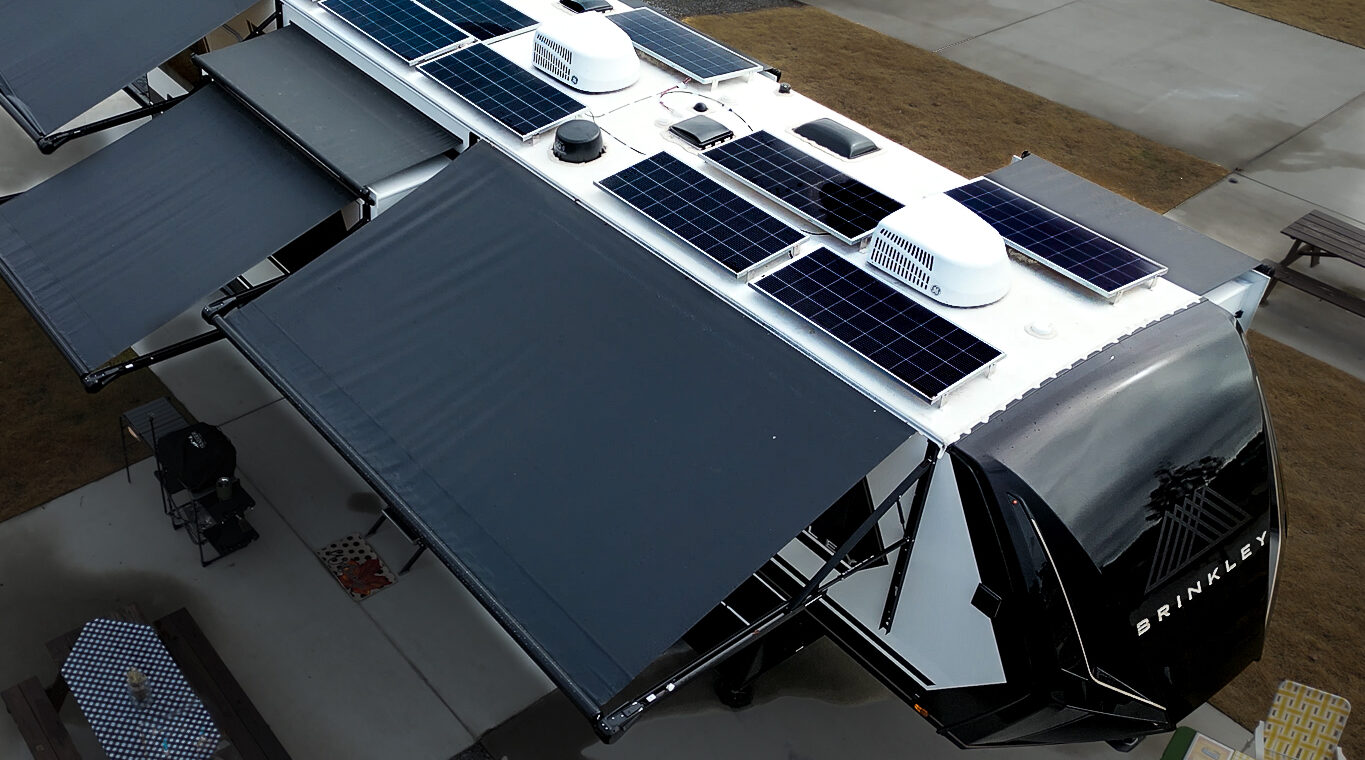
RV Solar Systems: What Do You Actually Need to Camp Off-Grid?

There’s a point in almost every RVer’s solar research when things start getting ridiculous.
You started out with a simple question: How much solar do I need for my RV?
Thirty minutes later, you have 14 browser tabs open and you’re comparing watts, amp-hours, volts, lithium batteries, MPPT charge controllers and inverter sizes while somebody on YouTube is explaining why the system you were considering is either wildly oversized or completely inadequate.
Here’s the good news.
Choosing an RV solar system doesn’t have to start with the equipment.
It should start with how you want to use your RV.
What Do You Want Your RV Solar System to Do?
This is the question that matters most.
Do you want enough power to keep your batteries charged while you’re camping without hookups?
Do you want to run lights, fans, a water pump, refrigerator and electronics?
Are you working remotely from your RV and powering laptops, Starlink, monitors and other equipment throughout the day?
Do you want to use regular 120V outlets without plugging into shore power?
Do you want to run a microwave?
What about an air conditioner?
Or are you building an RV specifically because you want to spend extended periods boondocking and need a serious off-grid electrical system?
Those scenarios require very different systems.
That’s why there really isn’t a universal answer to the question, “How much RV solar do I need?”
The Four Major Pieces of an RV Solar System
Most complete RV solar systems revolve around four major components: solar panels, a battery bank, a solar charge controller and an inverter.
The solar panels generate electricity when sunlight is available.
The battery bank stores energy so you can use it when the panels aren’t producing enough power — including at night.
The solar charge controller manages the power coming from the solar panels and sends it to the batteries at the appropriate voltage and current.
The inverter converts DC battery power into AC power that can operate many of the appliances and outlets you normally use when connected to shore power.
Then there are all the pieces that make those components work together: wiring, fuses, breakers, disconnects, busbars, monitoring equipment and other electrical components.
This is one reason comparing RV solar systems based only on the number of watts on the roof can be misleading.
Is 400 Watts of RV Solar Enough?
Maybe.
For someone with relatively modest electrical needs, 400 watts of solar can be useful. If your goal is primarily maintaining batteries and supporting smaller DC loads, you may not need an enormous solar array.
But 400 watts of panels doesn’t tell us how much energy you can store.
It doesn’t tell us the size of your inverter.
It doesn’t tell us what appliances you expect to run.
And it definitely doesn’t tell us how many days you want to stay off-grid.
A solar array that works beautifully for one couple could frustrate another RVer within 24 hours.
What About 1,000 Watts? 2,000 Watts? More?
Larger solar arrays become useful as electrical demand increases, especially for RVers who spend significant time away from hookups.
But bigger isn’t automatically better.
Your RV has finite roof space. It has weight considerations. You have a budget. And solar generation still varies based on weather, shade, season, panel orientation and other conditions.
The better question is:
How much energy do I expect to use, and how do I want to replace it?
Once we understand that, we can begin sizing the solar array and battery bank around actual demand.
Don’t Forget the Battery Bank
Solar panels get most of the attention because they’re the most visible part of the system.
Your batteries are arguably just as important.
Think of your solar panels as the faucet and your battery bank as the tank.
A powerful faucet doesn’t help much if the tank is too small to hold the amount of water you need overnight.
Lithium batteries have become extremely popular for RV solar systems because they offer substantially more usable capacity than traditional lead-acid battery configurations while also supporting the demands of larger inverter systems.
But once again, the right battery bank depends on what you’re trying to accomplish.
If you want to power a refrigerator, lights and electronics overnight, that’s one calculation.
If you’re expecting your battery bank to support air conditioning, that’s another.
Your Inverter Determines What You Can Actually Power
This is where an RV solar upgrade can dramatically change how the RV feels when you’re disconnected from shore power.
Without a properly sized inverter, you may have a fully charged battery bank and still be unable to use many of your normal AC appliances.
A larger inverter system can make it possible to use more of your RV the way you normally would while connected to shore power.
But inverter size has to match the rest of the electrical system.
Installing a massive inverter without sufficient battery capacity and appropriate wiring doesn’t create a great off-grid system. It creates an electrical system with one oversized component.
Everything has to work together.
Factory RV Solar vs. a Custom RV Solar System
Factory solar has improved tremendously.
For many RV owners, it’s a great starting point.
The important thing is understanding what the factory system was designed to accomplish.
“Solar equipped” doesn’t necessarily mean “ready to camp indefinitely without hookups.”
Your RV may already have panels but need additional battery capacity. It might have adequate battery storage but need a larger inverter. You might have plenty of equipment but discover that one component is limiting everything else.
That’s why upgrading an existing RV solar system doesn’t always mean replacing it.
Sometimes the best approach is identifying the bottleneck and building from there.
How Much Does an RV Solar System Cost?
There isn’t one useful number because RV solar systems can range from relatively simple upgrades to complete electrical systems capable of supporting substantial off-grid loads.
The cost depends on factors such as:
- Solar capacity
- Battery capacity
- Inverter size and configuration
- Existing equipment
- RV layout and available installation space
- Electrical upgrades required
- Monitoring and control equipment
- Installation complexity
A better way to establish a budget is to determine what you want your RV to do first.
Then build the system around those goals.
Otherwise, it’s very easy to spend thousands of dollars and still discover that the finished system doesn’t solve the problem you were trying to fix.
The Best RV Solar System Is the One Designed Around You
There is no magic solar package that is perfect for every motorhome, fifth wheel, travel trailer or camper van.
And that’s actually a good thing.
Your RV solar system can be designed around your version of RVing.
Maybe you want a little more independence from campground hookups.
Maybe you want to boondock for days at a time.
Maybe you’re building a mobile office.
Maybe you’re tired of listening to your generator.
Or maybe your goal is simple:
You want to look at an incredible campsite without hookups and think, Yep. We can stay here.
That’s ultimately what a good RV solar system should provide.
Not more equipment.
More freedom.
Ready to figure out what your RV actually needs? Talk with Go RV Solar about designing a solar, lithium battery and inverter system around the way you travel.

Co-Owner / Solar Advisor
Jason is the resident expert for anything that carries a current. Drawing on an extensive background in low-voltage tech and a deep history of RV inspections, he has a knack for making complicated systems work seamlessly. He’s the practical force behind the team, dedicated to high-quality builds and reliable energy solutions.


