How Battery Type Impacts Your Total RV Solar Installation Cost

WATTS THE LATEST

Posted On: January 26, 2026

How Battery Type Impacts Your Total RV Solar Installation Cost

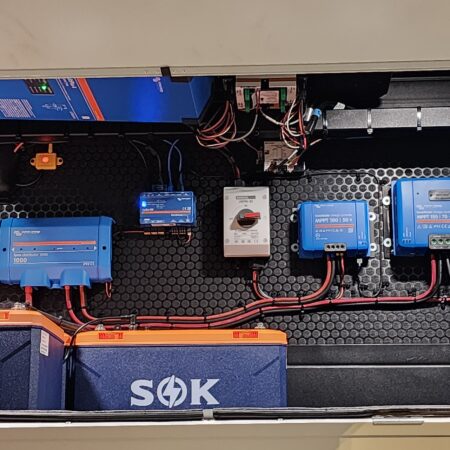
SOK Batteries Install | Go RV Solar

When planning an RV solar installation, most travelers focus on the panels. However, the battery bank is often the single most significant factor in your total project cost. Choosing between traditional lead-acid and modern lithium (LiFePO4) technology doesn’t just change the price of the batteries—it ripples through your entire system design.

At Go RV Solar, we believe in building systems that offer the best long-term value. Here is how your choice of battery chemistry impacts your wallet, your rig, and your overall RV solar installation costs.

Upfront Cost vs. Long-Term Value

The most immediate impact is the “sticker shock.”

  • Lead-Acid (Flooded/AGM): These are the budget-friendly entry point. You can often find a 100Ah AGM battery for $200–$300.

  • Lithium (LiFePO4): These represent a higher initial investment, typically ranging from $200–$500 for a high-quality 100Ah unit.

While lithium seems expensive, these batteries can last 10+ years, whereas lead-acid usually fails after 2–3 years. When you calculate the replacement frequency, lithium actually lowers your RV solar installation costs over the life of the vehicle.

Usable Capacity and "The 50% Rule"

Battery type dictates how many batteries you actually need to buy.

  • Lead-Acid can only be discharged to 50%, due to the voltage curve as the battery is drained. If you need 200Ah of usable power, you must buy 400Ah of batteries.

  • Lithium can safely be discharged to 80-90% (or even 100% in some cases). To get that same 200Ah of usable power, you only need to buy about 220Ah of batteries.

Pro Tip: Because you need fewer physical batteries with lithium, you save money on heavy-gauge wiring, larger battery boxes, and mounting hardware.

Weight and Fuel Efficiency

Batteries are heavy. A standard lead-acid battery can weigh 45–55 lbs. A lithium battery of the same size weighs about half that and provides nearly double the usable energy.

  • Impact: Massive lead-acid banks can exceed your RV’s Cargo Carrying Capacity (CCC).

  • Cost Link: Exceeding weight limits can lead to increased fuel consumption and premature wear on your tires and suspension.

System Component Compatibility

Your battery choice affects the cost of other parts:

  • Charge Controllers: Modern MPPT charge controllers are required to get the most out of lithium. While they cost more than basic PWM controllers, they increase efficiency by up to 30%.

  • Inverters: Lithium maintains a higher, steadier voltage under load, allowing your inverter to run heavy appliances (like microwaves or hair dryers) more reliably without triggering “low voltage” alarms.

Finding the Right Balance

If you only camp a few weekends a year at parks with hookups, AGM batteries are a cost-effective choice. However, if you are a “Power User” or full-timer looking to maximize your solar panels’ potential, Lithium is the gold standard for efficiency and long-term savings.

Ready to find the perfect battery for your build?

Contact Go RV Solar
📞 (863) 675-2424
📍 Winter Haven, Florida
💻 GoRVSolar.com